Click above
Recent research by the Passivhaus Trust have shown than MVHR is more effective in less airtight house than previously thought. Not only new buildings benefit. MVHR is not necessarily a niche technology for Passivhaus/EnerPhit certification.
Older housing stock undergoing additions and refurbishment, retrofit, including window replacements, can benefit significantly from part or whole house design and installation of Mechanical Ventilation with Heat Recovery systems. (MVHR)
.
The energy consumption of houses, indeed all buildings, falls into two broad categories: that used to build the structure which includes the ‘embodied energy’ of the materials, and the energy the building will use throughout its lifetime. We are generally more familiar with the last category as this is the energy consumption we see and pay for directly.
Up grading and adapting existing buildings is by far the better option to building new when it comes to reducing embodied energy. The selection of materials that require less energy to manufacture and transport contributes to reducing embodied energy. Knowing the source, the provenence of a material, taking care in specifing products and using resources.
Many of our new additions to buildings involve the refurbishment of large parts of the existing structure, that along with the new energy efficient parts can significantly reduce the energy that building requires. Two factors make a significant difference.
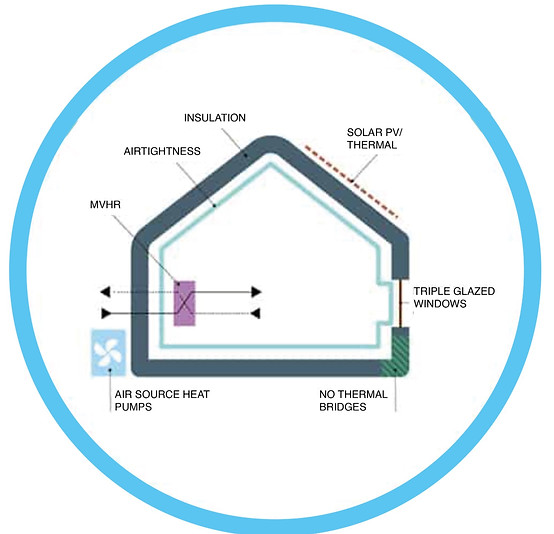
We all understand how better insulation, reduces heat loss, whether this be through double/triple glazing, loft floor and wall and cavity insulation.
The other factor is related to air tightness, how draughty the building and therefore how much produced heat will be retained. Whilst its an advantage to have a high degree of airtightness the building will also need good ventilation, regular air changes. Improving the thermal performance of your house comes down to controlling air changes. Ventilation systems with heat recovery is an ideal way to do this.
Mechanical Ventilation & Heat Recovery (MVHR)
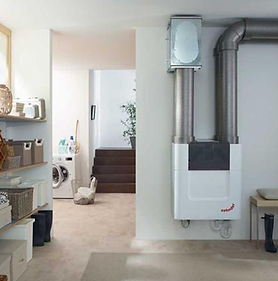
Mechanical Ventilation with Heat Recovery, MVHR, provides fresh filtered air into a building whilst retaining most of the energy that has already been used in heating the building. Mechanical ventilation with heat recovery (MVHR), heat recovery ventilation (HRV) or Comfort ventilation are all names for the same thing. A heat recovery ventilation system properly fitted into a house provides a constant supply of fresh filtered air, maintaining the air quality whilst being practically imperceptible.
Recent research by the Passivhaus Trust have shown than MVHR is more effective in less airtight house than previously thought. Not only new buildings benefit or is MVHR a niche technology for Passivhaus certification. Older housing stock undergoing additions and refurbishment, retrofit, including window replacements, can benefit significantly from part or whole house design and installation of Mechanical Ventilation with Heat Recovery systems.
.
Health and Well Being
By having an MVHR system specified, designed and installed it will provide you with the fresh quality of air required to live a healthy lifestyle. By filtering out pollutants (NOx/SOx), nasty particulates and pollen before it enters the home and extracting potentially damaging stale/humid air, VOC’s from cleaning products and furniture, as well as dust particulates, MVHR can create a balanced and healthy indoor climate for any home.
Generating Energy
For many homes Solar-Thermal Hot water systems and PV photovoltaic panels are two common methods of investing in your own energy generation. Developing an appropriate energy strategy for your home at the early stages of the design is an investment that will pay back quickly, reduce C02, and save you money.
Energy efficient and healthy comfort without costing the earth.
Air Source Heat Pumps

Building to a super insulated,airtight near-zero-energy level is not always possible. There are up-front costs and mechanical ventilation systems (MVHR) are necessary.
But we dont have to build to Passivhaus standards to make significant improvements to our homes. If a good level of insulation and airtightness is achieved then old gas/oil boilers can be replaced with Air Source Heat Pumps.
These heat pumps extract heat from the ambient air and supply a wet heating system much in the same way as a gas boiler is connected to a Hot water cylinder, Under floor heating UFH and ordinary radiators.
Located outside the house, heat pumps can be positioned discreetly and they make little noise. Running on electric (preferably from renewable sources) means that you no longer rely on fossil fuel to heat your home and there are grants available to help with the install costs.